
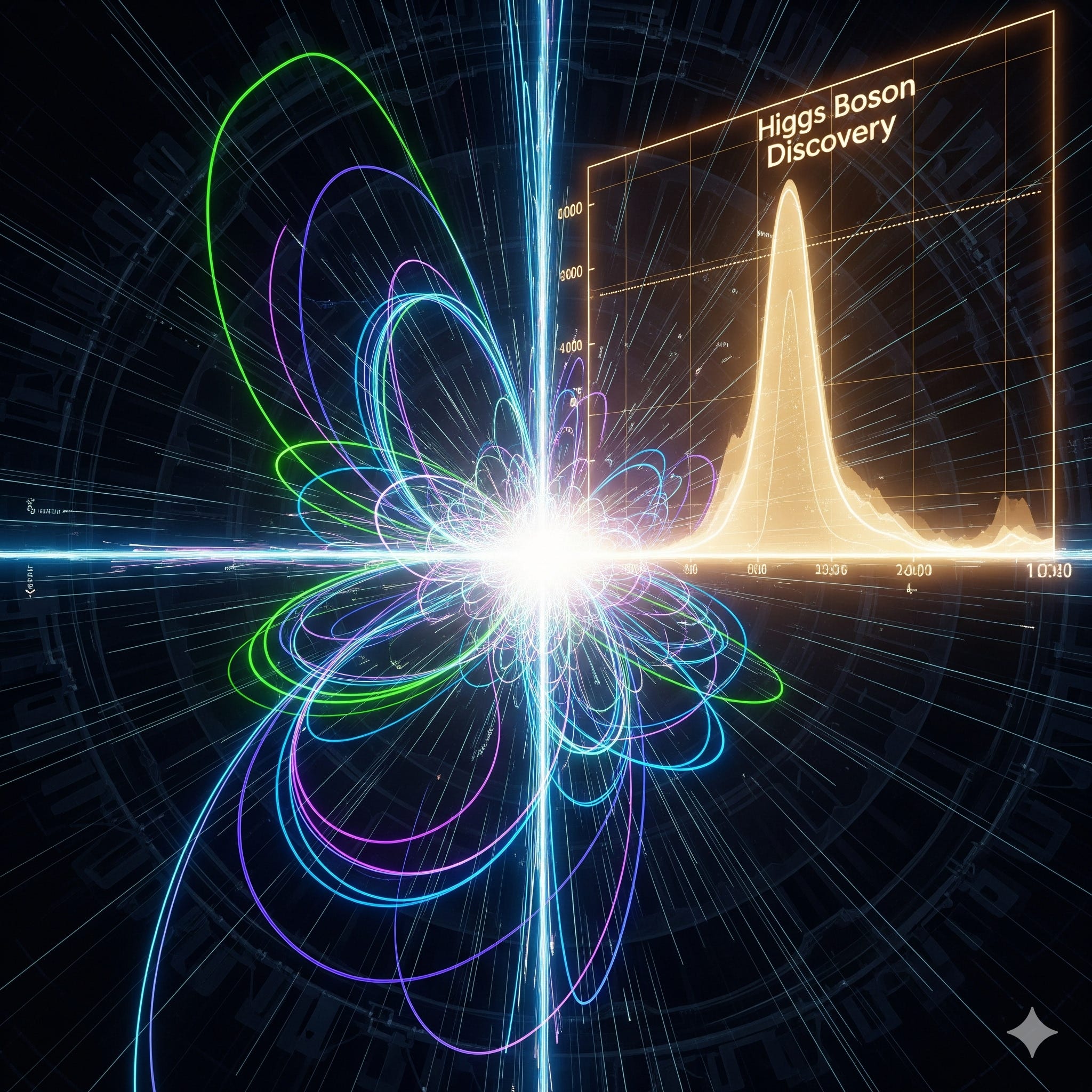
The Higgs Boson is basically invisible, making it very difficult for physicists to detect it. The way they do so, is by looking for the specific traces that the Higgs Boson leaves behind when it decays, which is almost instantaneously. About a trillionth of a trillionth of a second after the particle is created, it decays.
The Needle and the Loaded Dice
The Higgs Boson is an extremely rare-to-find particle, and physicists need to run many, many measurements and collect so much data, in order to look for the patterns that occur when a Higgs Boson is noticed. For example, if you roll a die once and you get a number, it doesn’t mean anything. If you roll a die thousands and thousands of times, and you notice that one particular number is coming up more than it should, this signals you that the dice are loaded.
The Rare Decays vs The Noisy Decays
The Higgs Boson decays into Bottom Quarks 58% of the time, but Bottom Quarks are the noisy decays of the Higgs Boson. The noise that bottom quarks produce are like trying to hear a pin drop in a jet engine test. Physicists came up with the solution, to ignore the common decays, and focus on the more rare ones, like the Two Photon Channel, and the 4 Lepton (Golden) Channel.
Quantum Weirdness Defies Math
Even though the Higgs Boson has a mass of about 125 GeV (giga electron volts), when it decays into Z Bosons, each Z Boson has a mass of 91 GeV. Two 91 GeV bosons would add up to 182 GeV, not 125 GeV. This is pure Quantum Weirdness, and the explanation behind this, is that one of the Z Bosons exist as a virtual particle, for a fraction of a nanosecond, just enough for the decay to occur.
The Hints and The Discoveries
In 2011, at the Large Hadron Collider (LHC) at CERN, the 2 independent detectors ATLAS and CMS were about to report their discoveries. Strangely, both competing detectors saw the bump at the exact same mass, both reporting 125 GeV. Though, this is all a hint. Not a discovery. The 2011 Hint measured 3 Sigma, which is about a 1 in 740 chance of being wrong. In quantum physics though, this is not enough to be claimed as a discovery. For a discovery, a 1 in 3.5 million chance of being wrong, or a 5 Sigma discovery.
Cautious Electric Excitement
Within the teams working on these hints and discoveries, the atmosphere was described as “cautious electric excitement”. After 2011’s hint, the plan for 2012 was clear. First, physicists would run the Large Hadron Collider at a higher energy, to increase the possibility of potential Higgs Boson creations. Then, they would collect as much data as possible, and analyze it to the core. Lastly, they would determine whether the 3 Sigma hint grows into a 5 Sigma discovery. Now, we must keep recording data, analyzing it, and cranking up 3 Sigma hints to 5 Sigma discoveries. The main question is, will the hints just fade away into the vast majority of Quantum that we have no idea about, or will they grow into discoveries and revolutionize the field?
Detective Physicists
Physicists need to act like particle detectives, in the way that they study the Higgs boson and create a picture of it, based on the evidence and traces it leaves behind. In this case, the Higgs Boson leaves behind other smaller and less massive particles, which physicists study, and use that to study more about the Higgs Boson itself.
Calculating Mass
The 3 steps physicists need to take to calculate the mass of a Higgs Boson are to measure the energy (e) of the particles it decayed into, measure the momentum (p) of the decay particles and lastly, to calculate the mass using the relativistic formula. The Invariant Mass tool can be used to find a particles mass without actually looking at it, and the five-sigma standard needs to be used in order to determine the chance of the discovery being a random fluke.
The Hope For the Bump
Physicists hoped to see a bump in the data graph, around 125 GeV (giga electron volts), signaling the Higgs Boson. Every new particle appears like a spike in the data, and this is what physicists were looking to observe. A large bump occurred around 91 GeV, which signaled the Z Boson, a new particle.
The Hunt is Over
On July 4, 2012 at CERN, the two competing detectors ATLAS and CMS presented their findings. In the front row, sitting there was Peter Higgs, the man who heavily contributed to the idea of the Higgs Boson. 48 years after Peter Higgs thought up the Higgs Boson, the hunt was finally over. Just like Peter Higgs, we should theorize and idealize future quantum physics concepts that still remain a mystery today. Like how ATLAS and CMS reported 5 sigma discoveries, we must make that happen continuously, and enhance the quantum world.
The Rulebook’s Missing Piece
The Standard Model of Particle physics is the subatomic rulebook for everything quantum, even though there’s a lot of information and concepts that it doesn’t cover. Without the discovery of the Higgs Boson in 2012, the whole Standard Model would have come crashing down. This discovery was crucial for the Standard Model to retain its place as the rulebook.
The Particles and The Tests
Multiple tests were applied on the Higgs Boson, and it passed every single one. From the ATLAS and CMS findings, Physicists measured its mass to be 125 GeV, about 130 times heavier than a single Proton, and this exact number was crucial to prove the discovery and observation of the Higgs Boson. In addition to that, measurements relating to the decay particles (Tau Lepton, Top Quark, Bottom Quark) took place.
The Upgrade and the Answers
The LHC (Large Hadron Collider) is getting a massive upgrade, in order to become a so called Higgs Factory. This upgrade boosts the LHC’s luminosity (how many interactions it gets) by 10, which is an exponential increase. About 15 million Higgs Bosons will get created in the LHC, per year. This will provide the answers we need, to unlock the mysteries of the cosmos, and to determine a lot more information about the Higgs Field and the Higgs Boson.