
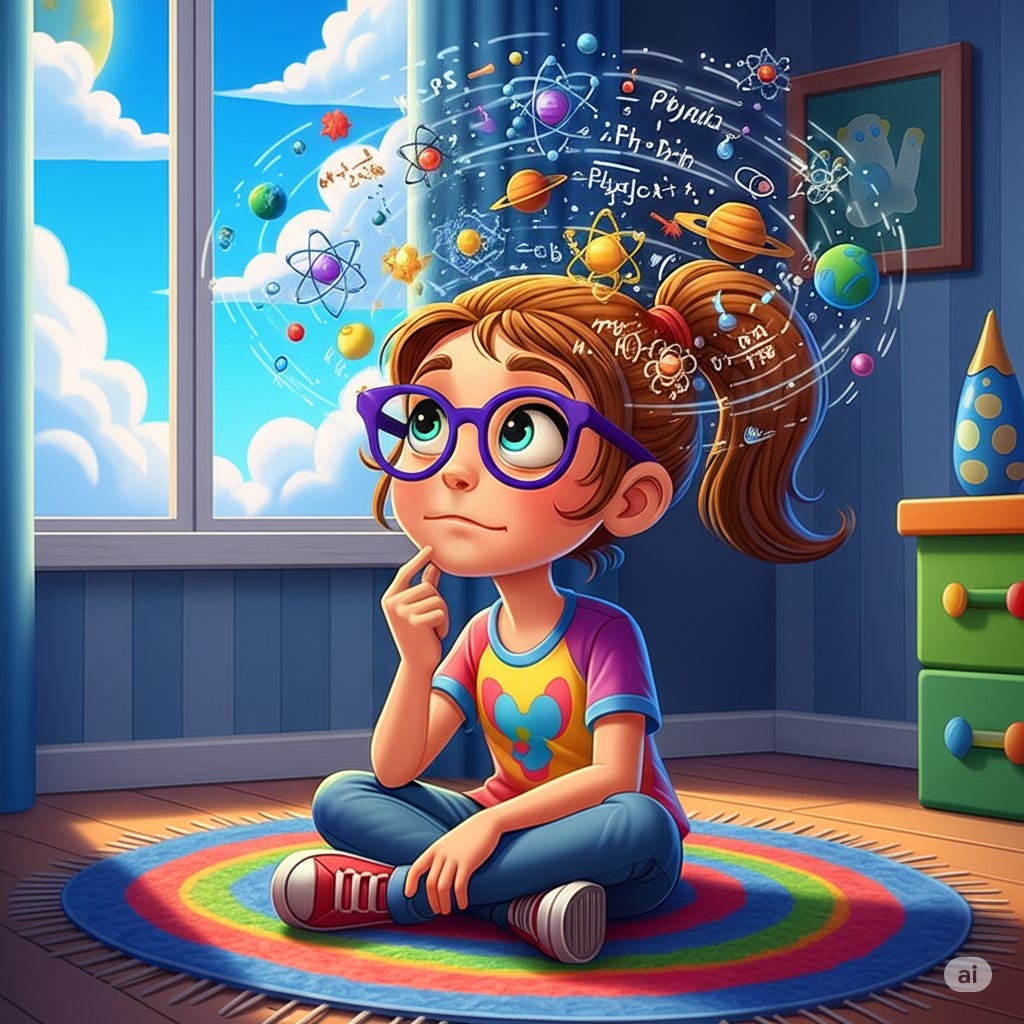
Art is what most people define as drawings, paintings, coloring and patterns. But there are more types than that - discovered, undiscovered and even imaginary! I’ve found the truth behind some of the unique arts, because they either used to or still apply to my daily life and I have a backstory for most of them. When someone sees art, they probably see pictures and colors. Not all try to find the actual meaning behind them - the story they try to tell. Just like a curtain. They see an ordinary curtain - not many people dive deeper to find out what is behind the curtain - whether a useless rusty old clock, or a key opportunity to make everyone’s lives better!
Art of Ignoring
“Ignoring” is a form of art. Whenever I feel perturbed in a bundle of nerves, I get anxious. I just feel like there are obstacles all around me, preventing me from doing regular things. I get trapped in this tight escapade - like a contraption that my own brain produced, and the only way to escape is practicing the Art of Ignoring. I just try my best to ignore the worry and distract myself with other things. The more I overpower the worry and eventually outnumber it, the escapade gets looser and looser until I am able to escape through an obstacle-less gap, and then I stop worrying. Even though it takes a lot of practice and time to master it, just like any other type of art, it is helpful to actually be able to ignore a worry, and live a rather worry-free life.
The Art of Mathematical Nature
Objects in nature like trees, plants and rocks are considered art, because of their shape, size, color and other properties. On flowers, the petals have patterns that differ from one flower to another and they follow the Fibonacci Sequence or the Golden Ratio. One sequence clip from the Golden Ratio is 0,1,1,2,3,5,8,13, and so on. The pattern here is just about adding each number with the number before it, to get the next number. This is neverending, like the decimal number sequence, or the irrational Pi (3.14159…). I feel a personal connection to the Fibonacci Sequence because, for one thing, it’s very complex and I love complexity. Also, the thought of mathematicians making a complex topic sound so inextricably simple is itself artistic to me. In other words, like the bell curve which has two extremes (both the flat tails) and the middle (the broadest, population-wise). Physicists and mathematicians move their discoveries and inventions from the complex extremes to the average means of the bell curve, making it another piece of art!
Mental Art
Transportation of information in the human brain is also an art. Neural pathways and neurons are fascinating, tempting to look at under an MRI scanning machine! The neural pathways and connections have a bidirectional, grid-like structure, which is also art, for the same reasons as patterns and designs are art. A neural pathway’s network structure replicates as a person gains new experiences and learns new things through their life. A picture of the human brain looks like a pink squiggly and slimy thing. That is another pattern, and patterns are art! Mental art is also when you gain new neural pathways from new experiences and new learnings. For example, I learn new topics in quantum physics (new learnings) and represent them in different ways like my podcast (new experiences), which in turn help me create mental art by gaining more neural pathways in my brain.
Imaginary Art
Just imagine something, like a raspberry, which has a unique color, shape, size and other unique properties, and that is made up of a number of atoms and subatomic particles like quarks, leptons and more. It is mentally and imaginarily artistic to me, how something as normal and simple as a raspberry can be decomposed into such tiny particles. I use this form of art in another way to keep me from getting bored - by creating imaginary creatures to talk and play with me. I usually have various names for the creatures, and they would speak various languages I invented and sometimes there are dictionaries for such languages. In my imaginary world, there is a place called Tanvitopia which is named after me, and which is my little world that has all my imaginary friends to talk to. My imaginary friends have an artistic way of keeping me entertained - artistic, because they use the various types of art I described and explain more about them for entertainment and to prevent boredom. With the real and imaginary world together, and all my real and imaginary friends, I’ve managed to overcome extreme boredom, extreme anxiety and extreme loneliness!
Visual Art
After you stare at the sun for a while (don’t actually do it!) and then look at the wall and blink a few times, you can see colored patches - yellow, green, red, pink, orange, you name it! These patches are just your brain playing tricks with your eyes, the information gets sent when it isn’t really supposed to. This color is art, and it is uniquely visual, so I call it Visual art!
Neutral Art
Let’s say there is a hole in the ground. A pitch black hole. You stare into it (don’t fall in!) and find nothing but darkness. It’s dark, black with absolutely no light from anywhere under there. You can easily relate this with the Mariana Trench (the deepest ocean point on Earth). This is, strangely, also art - and it is black. Black is not really a color - it is the output after absolutely no photons, neutrinos or any particle of light bounce off of a surface. Colors are caused by light bouncing off of objects and black is the output of no light bouncing off. Even though it isn’t colorful, the whole idea of black is eye-catching. It is artistic that even though light is almost everywhere, we can create full patches of absolutely nothing.
Art in the Dark
When you close your eyes, and if you are next to any sort of object that is a source of photons or neutrinos currently bouncing off of objects, the background doesn’t appear completely black. It is a bit orange, maybe red. Sometimes when you close your eyes super tightly, you can even see small patterns, like swirls and hexagons. That’s because some photons can still enter your photoreceptor cells in your retina (the part of your eye that takes in light). The typical human eye absorbs blue light better than red light, so your eyes are used to blue light. When you close your eyes, some red light just passes through, which is why the background would have a reddish tint. They are like optical illusions, but they are actual colors - with artistic patterns! Sometimes when I am bored, practicing this art just makes me feel more entertained. There are red, blue and black patches that I see, like an art gallery with different picture frames, each one with a unique color or pattern, all of them residing inside my eyes!
Art of Humanity
This can be considered in two different ways. The first one is that it is amazing to just be alive on planet Earth. This is art because when people are not yet born (still forming) they develop arms, legs, hands and more. The first ever things to develop are a heart, and a heartbeat. That has patterns, beats, colors - so, art! Another way to look at it is that the skin and other properties of humans are considered art because of their unique patterns and colors. It is fascinating to think how humans evolved, and how we are here today in ways more artistic than what we could think of.
Art is very important in life, especially for complicated individuals like me who love analyzing everything. Art gives us a very easy way to do so!
Since I have anxiety, I've used the “Art of Ignoring” to learn to ignore all my worries, as it weighs down the pressure to do daily activities. It makes me strong enough to overpower all my worries. By practicing the “Art of Ignoring”, people can come a long way in life, achieve things better than they would without using the method. Sometimes I like to walk around slowly, and appreciate the fact that I am alive, using the “Art of Humanity”. “Mental Art” is also one I use frequently, in fact every single day! Since I learn complex topics like Trigonometry and Quantum Physics, these are new learnings and new experiences. This way, I am creating “Mental Art” in my own brain every day, by creating new neural connections and rewiring neural pathways!