
Have you ever stood in front of the kitchen stove, waiting for a pot of water to boil so you can make mac and cheese, and felt like it was taking forever?
You know, they say, “A watched pot never boils.”
In our normal world, we know that’s just a myth - the water IS gonna boil whether you look at it or not. But what if I told you that in the crazy, rule-bending world of quantum physics, a watched pot literally never boils?
In the quantum world, subatomic particles don’t behave like everyday objects. Instead, their properties exist in a state of probabilities until they interact.
When a subatomic particle is measured, or observed, it’s forced to collapse into one state. In quantum, the concept of “observing” is when you measure the state of a particle.
Normally, when a quantum system is left completely isolated, its wave function keeps evolving over time. What that means is, the particle is constantly transitioning between different energy states or positions.
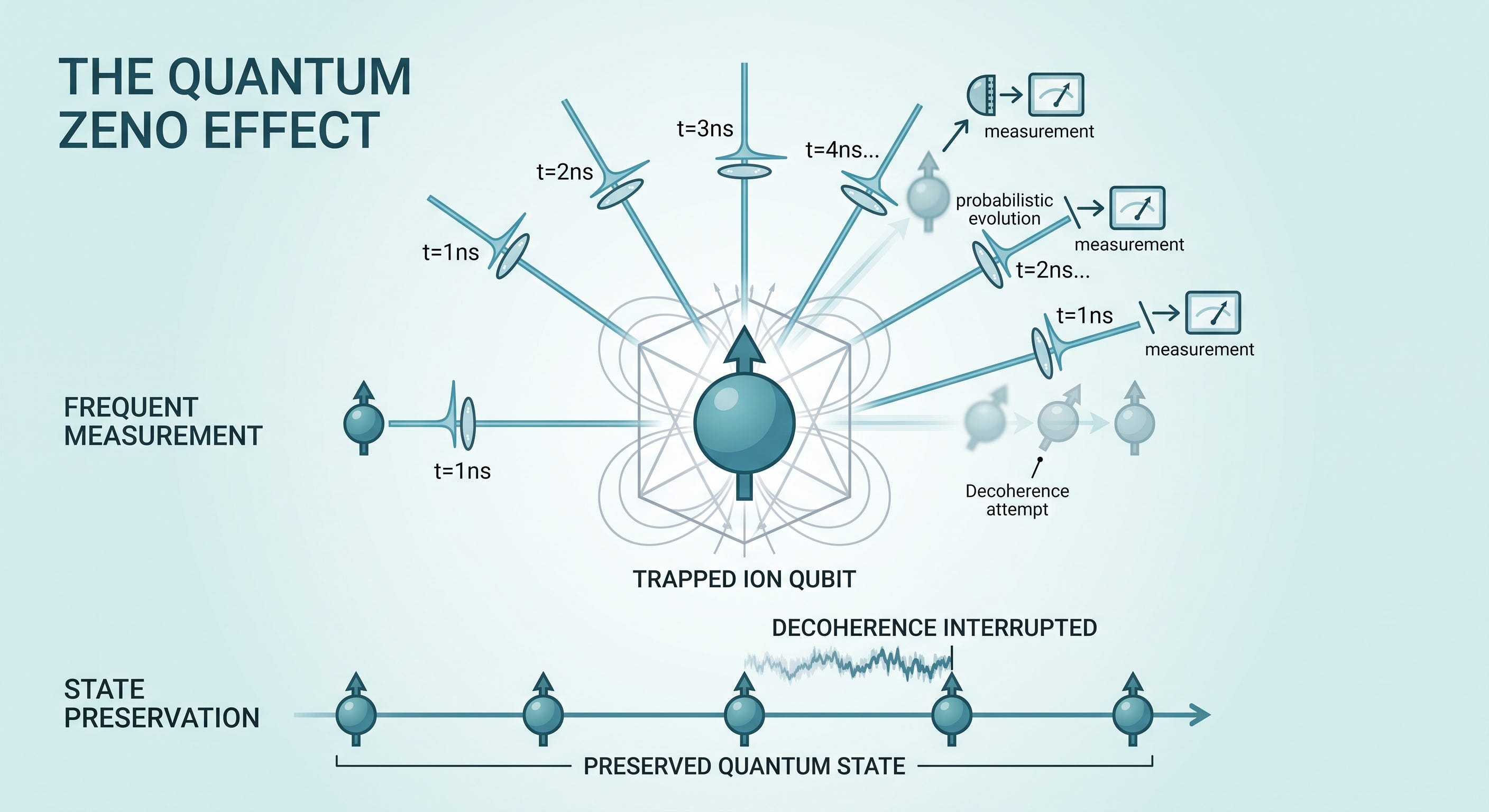
However, the exact moment an observer takes a measurement, this evolution is interrupted - causing the wave function to collapse into one singular state.
It’s just like playing a game of Red Light, Green Light - only, with the universe. Every time a measurement is taken, the particle is forced to freeze - the measurement practically stops time for the particle! Just like a red light!
The particle cannot continue its natural quantum evolution until the observation stops. When the observation finally breaks, it’s a green light.
So, if you perform measurements, with no stops or breaks, the system is prevented from decaying, or changing at all - as if it was really frozen.
In classical physics, if an object is moving, it keeps moving whether you blink or not. But in the quantum world, time and motion depend entirely on how frequently a quantum system is analyzed.
When a quantum particle is left alone, the probability of its state changing increases over time. But here’s the catch - right at the very beginning of that transition, the change happens super slowly!
If a scientist performs another measurement during that initial tiny window of time, the wave function is forced to re-collapse back into its original state.
When the time window is very small, say 10-30 minutes, the probability that a quantum system will change decreases. When the time window is very large, say 5 minutes, which is very large in quantum, the probability that a quantum system will change increases.
Either way, when the system is measured, it resets back into its original state. When a scientist keeps on measuring the particle, over and over and over again, it keeps getting reset, and never really comes out of its original state.
So, why do physicists spend so much time trying to freeze these subatomic particles in place? Why does it even matter? Why do physicists even care about freezing subatomic particles?
The answer lies in the weird and crazy world of quantum computing, where the Quantum Zeno Effect acts as the king of all stable matter.
The big challenge here is that qubits are incredibly sensitive to their environment, and any outside interference - like a tiny change in temperature - causes decoherence. Decoherence is when qubits lose their quantum properties and error out. This is where our non-blinking physics trick saves the day!
It acts like a real-time error-correction shield, preventing the quantum information from decaying before the computer finishes its calculation. Building a reliable, super-powerful quantum computer would be completely impossible, without the ability to freeze these volatile systems, using the Quantum Zeno Effect.