
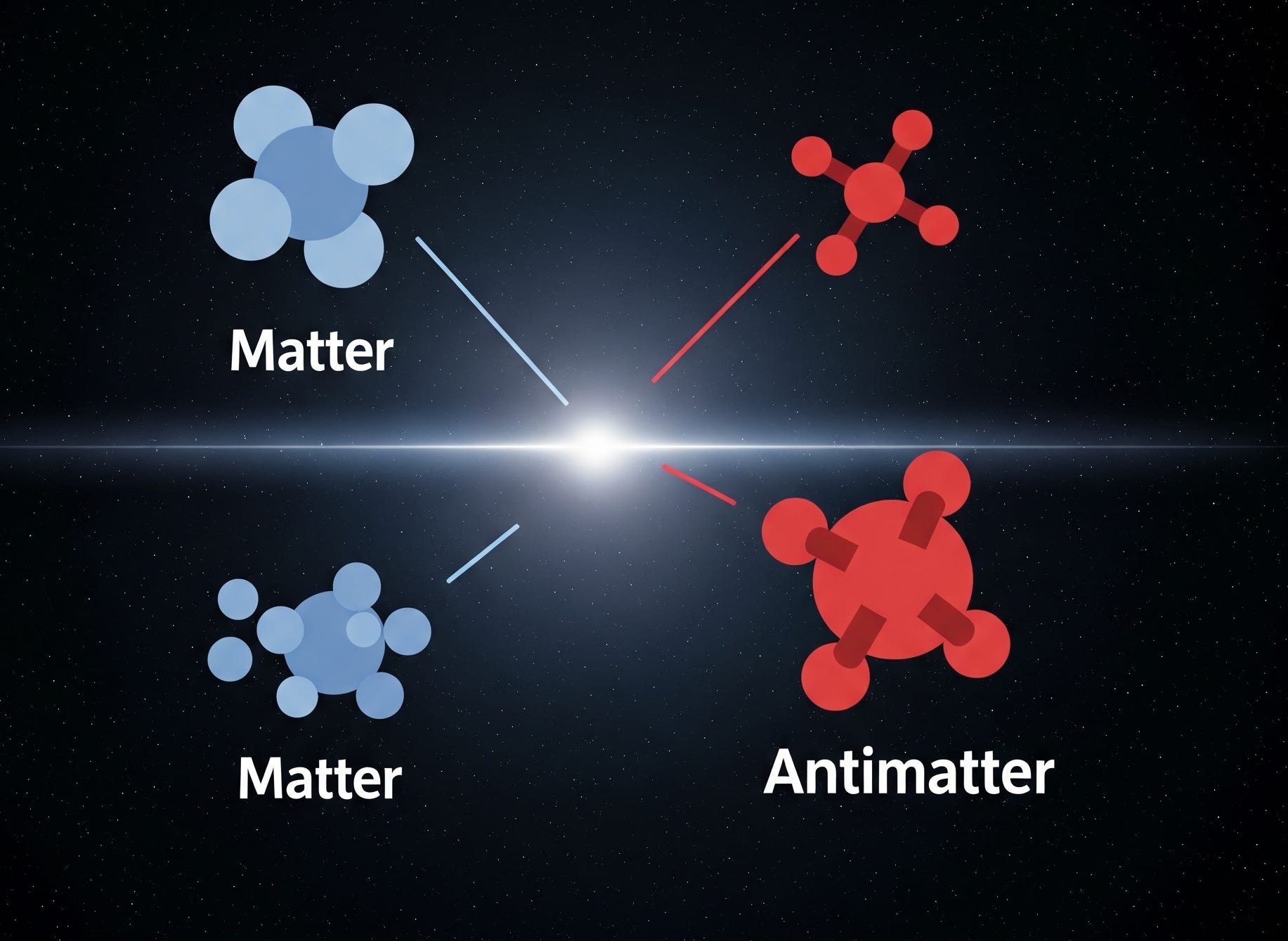
The Matter-Antimatter Asymmetry Problem is the imbalance of matter and antimatter particles that the Big Bang created at the beginning of the universe. Roughly, for 1 billion antimatter particles, there was 1 billion and one matter particles, creating a tiny imbalance. The tiny imbalance of a particle was all that was left, to create all the matter we see today.
The imbalance between matter and antimatter
For example, on a scale, if there are 1 billion yellow calculators on one side, and 1 billion and one purple calculators on the other side, the side with 1 billion and one purple calculators will be slightly below the side with 1 billion yellow calculators. This indicates an imbalance. The same way, if the yellow calculators represent antimatter particles and if the purple calculators represent matter particles, then there is a tiny imbalance between the matter particles and the antimatter particles.
The Background of this imbalance
The Matter-Antimatter Asymmetry Problem, also called the Baryon Asymmetry Problem was brought into existence by physicist Paul Dirac and Carl David Anderson. Dirac first proposed the existence of antimatter, and Anderson then proved it. The big question for them to build on, was the Matter-Antimatter Asymmetry Problem.
How scientists study matter and antimatter
Scientists research in the Large Hadron Collider (LHC) in Geneva, Switzerland. There, they can use the particle accelerator to smash/collide particles together, creating an environment similar to the one at the Big Bang. This way, they can study the behavior of matter and antimatter.
Do we know everything about matter and antimatter?
In the study of matter and antimatter, beyond the Matter-Antimatter Asymmetry Problem, there is still so much to discover. Matter and Antimatter are present in particle accelerators, in Earth’s radiation belt, and even near Black Holes and leftovers of Supernovas. As physics progresses, and generations of scientists study more and more about matter and antimatter, we’ll answer a lot more questions, and ask a lot more too.